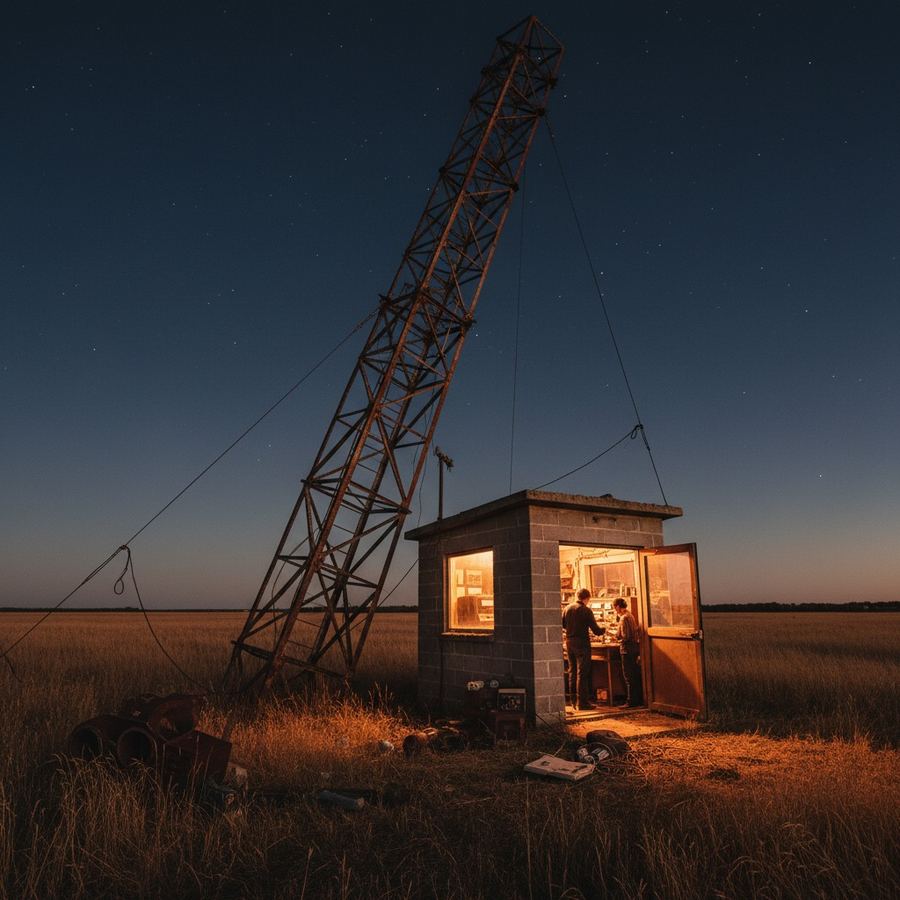
There is a gravel road in western Kansas that ends at a chain-link fence and a wooden pole stub where a 250-foot self-supporter used to stand. The transmitter building is still there. Someone took the copper out of the tuning house in 2019 and the rest of the doghouse is rusting in place. The license it served was a 500-watt Class D daytimer on a graveyard frequency nobody remembers unless they grew up listening to the 6:40 a.m. grain report. It filed silent with the FCC in the spring of 2017. The twelve-month clock ran out the next spring. The license was deleted and the frequency was never reclaimed. This happens somewhere in the country almost every month now, and has been happening at roughly that pace for a decade.
The small-market AM station is not extinct. It is, however, in a phase of its life cycle where the demographic math does not work. The stations still on the air are usually there because one or two stubborn owners are underpaying themselves and doing their own tower maintenance on a ladder. The rest are sitting in silent status waiting for the calendar to run out.
The squeeze
There is no single reason small AM collapsed and that is part of why it collapsed. The economics came apart from several directions at once.
The first direction was advertising. Small-market AM was built on car dealers, banks, furniture stores, feed lots, ag equipment dealers, and a long tail of storefront businesses that bought spots by the month on a handshake. Starting in the late 1990s the car dealers consolidated and moved their spend to cable television and then to digital. The furniture store closed when a big box opened twenty miles down the highway. The feed lot got bought by a national. Every client category that had been buying a schedule for twenty years stopped buying, not because of anything the station did, but because the client no longer existed in the form that bought radio. By 2010 a small-market AM that had once carried forty paid accounts was trying to make payroll off eight.
The second direction was coverage. AM propagation depends on ground conductivity during the day and on skywave bounce at night, and neither survives well in the modern electrical environment. Plasma televisions, LED bulb drivers, variable frequency drives on HVAC units, switching power supplies in everything from cell phone chargers to EV inverters, all of it dumps broadband hash into the AM band. A station that covered a county in 1985 with a clean signal now has a noise floor inside the listener's own house higher than the carrier.
The third direction was labor. When automation got cheap, it got used. A station that had employed two full-time announcers, a news director, a part-time board operator, and a sales manager could run in 2012 with one person logging commercials and a voice-tracked overnight from a sister station four markets away. That saved money short term. It also hollowed out the product so thoroughly that the remaining listeners, the ones used to hearing a neighbor read the obituaries, stopped turning it on. The feedback loop of small-market broadcasting: revenue drops, so you cut staff; the cut kills the local sound; the audience leaves; revenue drops again. The staffing side of this is treated in more detail in volunteer DJ culture in small-market stations.
AM revitalization
The FCC did notice. In 2013 the commission opened the AM Revitalization proceeding and followed it in 2015 with a Notice of Proposed Rulemaking. The centerpiece, and the one that actually got used, was a window allowing AM licensees to acquire or move an FM translator to rebroadcast the AM signal. The AM transmitter would keep serving the legacy daytime coverage area, the FM translator would carry the same programming into the noise-poisoned in-city environment, and the combined package had a fighting chance against the interference problem.
The 2016 and 2017 rulemaking orders opened translator application windows specifically reserved for AM licensees, and what followed was the translator gold rush. Between 2017 and 2019, several thousand AM stations picked up an FM translator companion, many bought for a few thousand dollars from speculators warehousing vacant construction permits from earlier windows. It worked by letting a 1 kW AM daytimer sound like an FM in town while still fulfilling its AM license. The rule required a minimum amount of AM simulcast on the translator, but in practice many translators carry a tighter playlist and a separate local ID, and the underlying AM is a legal technicality keeping the translator eligible. The commission also proposed a new Class C4 service in the FM band in the same proceeding; that part has sat in limbo for years. The full paper trail under proceeding 13-249 is on fcc.gov.
The directional antenna problem
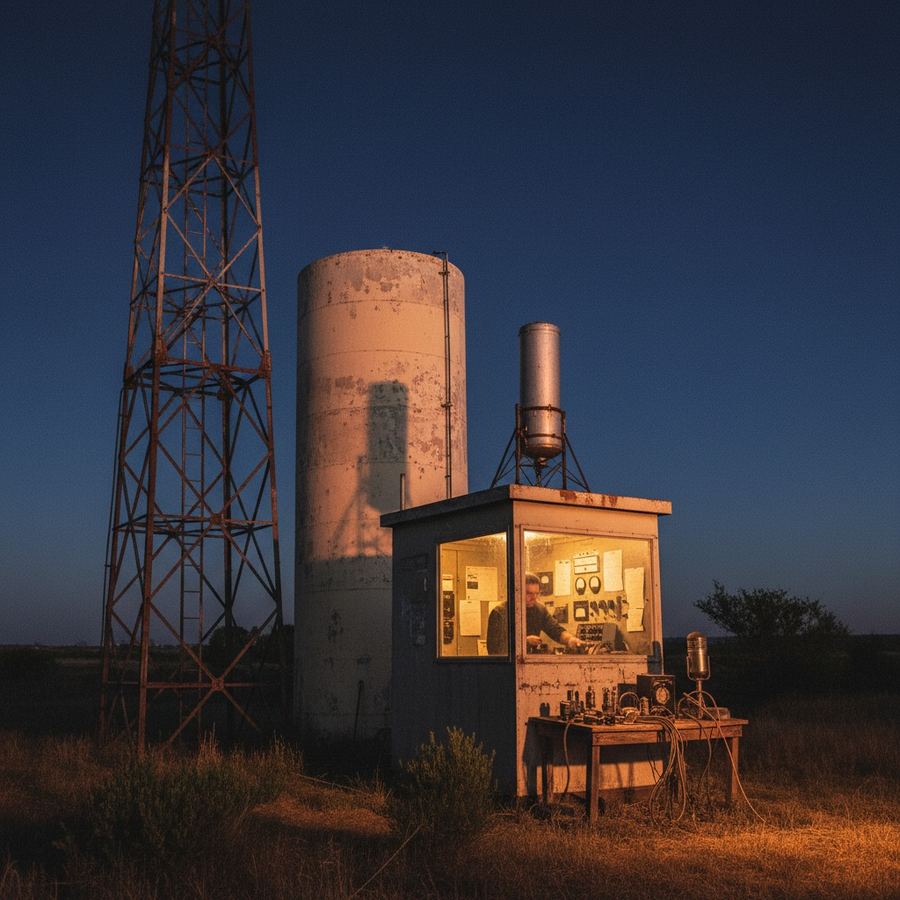
One thing that does not get written about enough is the tower maintenance burden on a directional AM. A non-directional AM has one tower, a straightforward ground-mounted radiator. A directional AM has two, three, or four towers in a specific geometric pattern, each driven by phased current through a complicated passive network in a phasor cabinet, and the whole array has to be retuned on a schedule and after any significant weather event. The FCC proof-of-performance requirement for a directional system is not trivial. It requires a contract engineer with the right test equipment; if the array is out of tolerance the station runs at reduced power or goes silent until it is fixed.
For a small-market directional protecting a dozen other stations at night, keeping the array in compliance can eat the entire profit margin. That is before you consider what happens when a guy wire rusts through, a tuning house floods, or lightning takes out an antenna monitor. Contract engineering rates climbed steadily through the 2010s and 2020s because the older generation of broadcast engineers aged out and the bench behind them was not deep. More than one station went dark not because the license was worthless, but because no engineer within driving distance would take the work at a price the station could cover. The bureaucratic side of what happens after the transmitter stops is covered in when stations go dark.
The land is worth more than the station
And then there is the real estate problem, which is the unsentimental ending for a lot of small-market AMs. A parcel bought in 1948 to hold a ground system at the edge of town is now surrounded by a subdivision. The parcel is worth two million dollars to a developer and the station on it maybe a hundred thousand. Nobody with a fiduciary obligation to an estate is going to keep the tower up under those conditions. Towers come down, ground radials get pulled out and sold for copper scrap, the site is remediated, the houses go in, and the FCC gets a silent-station notice that the license is not returning. The long arc of how the real estate dynamic played out across the band is in AM versus FM, the cultural shift.
What still works on small AM
The stations still viable in 2026 are the ones that did one of a small number of things with conviction. High school sports, called honestly by someone who grew up watching the same teams, is a format nobody else can do. Agriculture news and grain markets at 5:45 a.m., for people already in the pickup truck, still beats a smartphone app for the listener who does not want to take a hand off the wheel. Local talk that is actually local, a host who takes calls from people in the town rather than a national feed with a window for local promos, pulls an audience that feels seen. Specialty programming like bluegrass, polka, traditional country, gospel, and ethnic-language hours, scheduled in predictable blocks, keeps small constituencies that will travel to hear the station. None of these make a corporate owner rich. All of them are reasons the signal is worth keeping on. More examples are in the station stories archive.
The disappearing small-town AM station is not a single event. It is a rolling, market-by-market attrition that will keep going until the remaining stations are the ones owned by somebody who is not in it for the money. That is probably where the band ends up: smaller, stranger, more local than the consolidated version that killed it, quietly on the air at 1340 or 1490 or 1230 kHz for anyone still listening. When the subdivision backhoes start pulling copper radials, that is usually the sign the decision got made without anybody taking a vote. The license disappears off the database the next morning and the frequency is just noise.