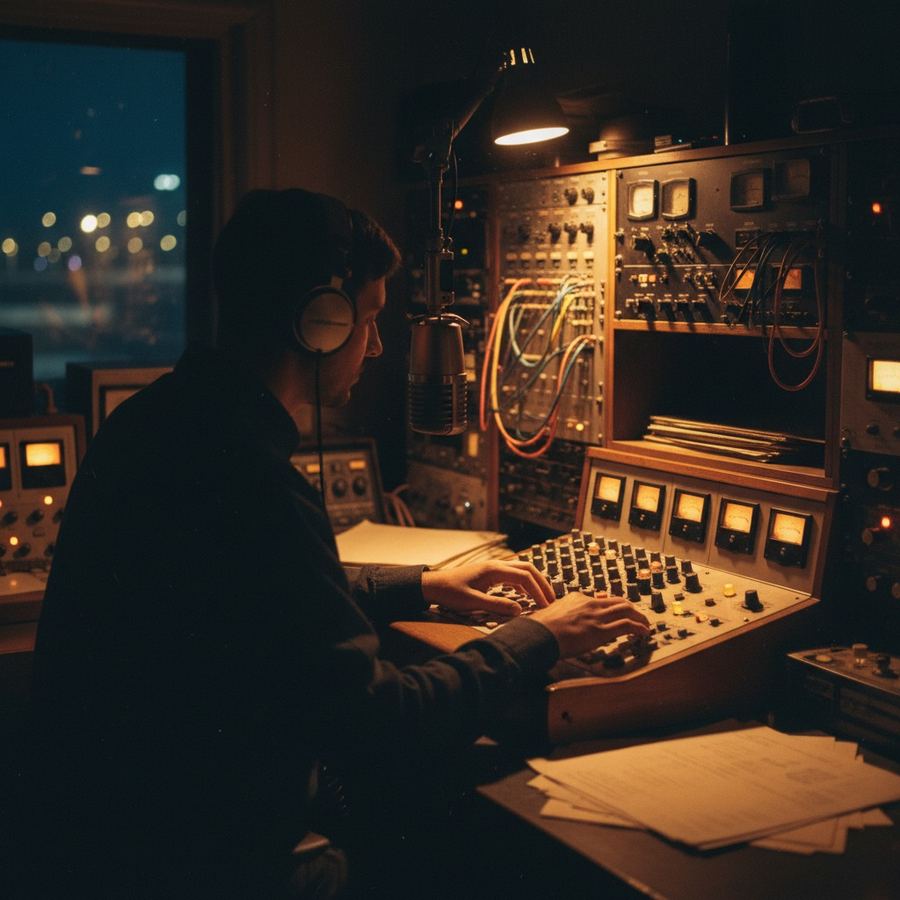
On a Tuesday night in a town of 14,000 people, somewhere in the middle of the country, a 62 year old retired welder is sitting in a small room with carpet on the walls, running an analog mixing board he taught himself to use six months ago. His show is called something like Midnight Shuffle or Back Porch Blues. He does two hours of records he picked out that afternoon, reads three community calendar items from a clipboard, misses a legal ID by about forty seconds, and plays a Jimmy Reed track he has been waiting to play for a week. Nobody is paying him. About 180 people are probably listening.
This is what volunteer DJ culture looks like in a small market community station, and it is the actual engine of American community broadcasting. Every LPFM and small-market NCE station in the country depends on some version of that retired welder, or the college sophomore who does a punk show on Sundays, or the retired high school Spanish teacher who produces a Saturday morning program in three languages. They are the only reason most of these stations exist.
Who they actually are
The volunteer DJ population sorts, roughly, into five groups. Retirees make up the biggest block, especially in stations more than five years old, people with flexible schedules and a lifetime of listening behind them. College students are the second bloc, concentrated near universities, bringing energy and recent genre knowledge but turning over within four semesters. Music obsessives form a smaller but weirdly influential group. Civic-minded folks who want to do local news or public affairs. And the occasional working professional willing to give up Wednesday nights for it.
Most came in through a "get involved" link, did a few hours of unpaid training, sat in on other shows, took a basic test on FCC board operation, and eventually got a regular slot. Almost none had any broadcasting background. In a commercial context this would be unthinkable. In community radio it is the baseline assumption.
The difference from a format station
The single largest cultural gap between a volunteer DJ and a commercial-format jock is permission. A country jock in a medium market might pick zero of the records that play on her shift, write zero of her intros, and follow a clock so tight that her talk breaks are timed to the second. A volunteer DJ on a community station typically picks every track, writes every break, and decides where a show is going in real time. If she wants to play a twelve minute Sun Ra side and then follow it with a Patsy Cline deep cut, no program director is going to stop her. The freedom is nearly absolute within the bounds of FCC indecency rules, the station's public file obligations, and whatever informal understanding the DJ has with the program committee.
That freedom is also the hardest part to use well. Most volunteer DJs, especially in the first year, over-rely on pre-built playlists, forget to say the station ID, talk too long, or play music that nobody outside their specific friend group is going to enjoy. Others, very quickly, discover that two hours of completely unformatted radio is harder than it looks and start quietly imposing their own structure. A good volunteer show, after a year or two, usually has a shape. It has bumpers and regular features. It rewards a returning listener. The best ones sound loose without actually being loose.
Training and the FCC minimum
Training is uneven across stations, but there is a floor. Every DJ has to understand how to run the board without over-modulating, how to read a legal ID at the top of the hour (station call letters and city of license, in that order, within ten minutes of the hour), how to respond to an Emergency Alert System tone and generate a required weekly test, and how to avoid the categories of indecent and obscene content that can generate FCC complaints. Many stations also train volunteers on the public inspection file obligation, now mostly maintained in the FCC's online public file system, and on quarterly issues and programs list requirements. Stations that skip this training end up with problems at license renewal time.
A few community stations have a formal staff role called something like DJ trainer or volunteer coordinator, typically a part-time paid position funded out of the general budget. This role is chronically underpaid and chronically essential. When it goes unfilled, the pipeline of new volunteers stops, and the station ages into its existing cohort until that cohort burns out.
Specialty shows and the freeform tradition
Specialty programming is the most visible output of volunteer DJ culture. A functioning small market community station might run, in a single week, a local blues show, a polka program for an older audience, a bilingual Latin music show, a jazz program hosted by a retired music teacher, a punk and hardcore show on Saturday nights, a gospel hour on Sunday morning, and a freeform experimental program that refuses description. None of these would get onto a commercial or format-driven public radio outlet. All of them exist because a volunteer built one.
The freeform tradition owes most of its cultural memory to full-power pioneers like WFMU (still the gold standard, now broadcasting from Jersey City) and the old Pacifica stations WBAI and KPFA, but the living practice of it is mostly happening on LPFMs and small-market NCEs now. For background on how those Pacifica stations fit into a different piece of the community radio ecosystem, see public access versus community broadcasting.
168 hours a week
There are 168 hours in a week and a radio station has to fill all of them, or else run pre-recorded content, or run satellite feeds. This is the schedule problem, and it is the single most important operational constraint facing any volunteer-driven station. Prime time (weekday afternoons and evenings) fills up fast because volunteers prefer slots when people are actually listening. Overnights (midnight to 6 a.m.) and mid-weekday (10 a.m. to 2 p.m. on a Tuesday) are the dead zones. Stations patch these with automation, long-form syndicated programming from PRX or Pacifica, NFCB member exchanges, or repeats of specialty shows.
A station with, say, thirty weekly volunteer shows covers about 60 hours of live programming and automates or syndicates the rest. A station with only ten volunteer shows is running satellite or pre-recorded content most of the time. You can hear the difference immediately when you drop in.
Burnout
The burnout problem is the part that nobody at a community station wants to talk about but everyone knows. The DJ who does a weekly two-hour show is fine. The DJ who does a weekly show and also fills in for dropouts and runs the music library and maintains the website and writes the quarterly issues and programs list, for five years, is not fine. Small community stations end up with a tiny core carrying disproportionate weight. When one of them leaves, the station wobbles. When two leave in the same quarter, it can go dark within six months.
The stations that survive a decade or more have typically figured out two things. First, they separate the air shift from the station work, so a volunteer who just wants to DJ can just DJ without getting pulled into governance. Second, they pay for the roles that require continuity, even if that means a single part-time coordinator splitting FCC paperwork and volunteer training.
Governance and the tough decisions
A volunteer station is a social organism. Someone has to decide who gets a show and who gets asked to leave, which programs get moved to overnights when a new volunteer wants their slot, and what happens when a long-running host's content stops matching the station's stated community service mission. These decisions are handled in different ways at different stations. Some have a program committee that meets monthly and votes. Some have a station manager who makes the calls and then defends them at board meetings. A few try pure consensus, which works exactly as well as you would expect with twenty opinionated volunteers in a room.
The argument that runs through most of these decisions, in the background, is the same argument that has run through community radio since KPFA went on the air in 1949: whose community, whose voice, and who gets to decide. Volunteer DJ culture is the place where that argument happens most directly, week in and week out, usually without anyone calling it an argument at all. It is a messy and deeply specific institution, and nothing in the rest of American media really looks like it. For more on the policy frame around that, see how low-power FM changed community radio and why local radio still matters.