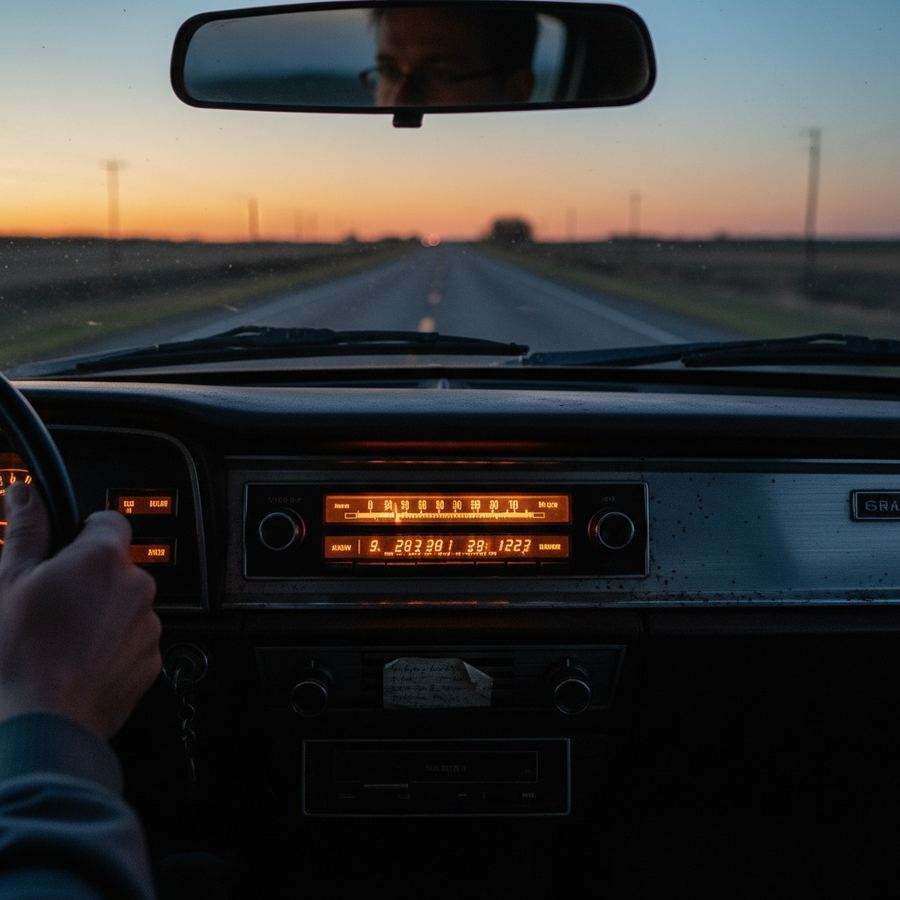
A decent car radio, a two-hour drive, and a willingness to sit with whatever comes in on the scan will tell you more about the state of American broadcasting than any industry report. That is roughly the working premise of the Listening Guides section. Most writing about radio is aimed at the people making it. This part of the publication is aimed at the people using it, and specifically the readers who want to listen more attentively instead of just leaving something playing in the background.
Listening as a practiced skill
Radio listening is not complicated, but it does reward a little structure. Knowing the difference between a full-power class C FM and a small class A changes what you expect out of the same frequency in different markets. Knowing that AM signals travel by groundwave during the day and skywave after local sunset explains why a station you could barely hear at noon is clear across three states at midnight. Knowing what the NOAA Weather Radio frequencies are, why LPFM is capped at 100 watts, and how HD Radio multicasts work on the FM band will change how you read a dial. None of that is obscure, but none of it is automatic either.
The guides in this section try to build that practical vocabulary without turning it into engineering homework. The goal is a reader who can walk into a new city, spend an hour scanning, and come away with a working sense of what the local radio landscape actually looks like.
Shortwave, ham, and the rest
Shortwave listening (SWL) is a smaller hobby than it was in the 1970s and 1980s, partly because many of the old international broadcasters scaled down their HF services in the 2000s as streaming took over. But HF is still active. There are still state broadcasters, religious broadcasters, time signal stations like WWV and WWVH, utility traffic, pirate stations around 6925 kHz on weekend evenings, and a steady amount of amateur radio voice and digital activity. A modest portable radio with SSB reception will pull in most of it. The shortwave guide in this section is aimed at someone who has never tried and does not know where to start.
Ham radio is a separate world from broadcast listening, and conflating the two is one of the most common mistakes newcomers make. The amateur bands are licensed two-way allocations, not broadcast services. Listening is legal, but you cannot transmit without a license, and the programming culture is completely different from a broadcast station. The ham-versus-broadcast guide exists specifically to draw that line clearly.
Articles in Listening Guides
PRACTICAL
How to Find Good Local Radio Stations
Scanning strategies, when to try the AM band, what to listen for in the first two minutes, and how to tell a local voice from voice tracking.
PRACTICAL
Shortwave Listening Basics for Beginners
Which HF bands to start on, what a cheap portable gets you, the role of SSB, and realistic expectations for DX in 2026.
REFERENCE
Ham Bands vs Broadcast Bands Explained
The legal and cultural distinction between amateur radio allocations and broadcast services, and why the two are not interchangeable.
Start with the local stations guide if you mostly listen in a car. The shortwave piece is the right second read if you want to extend beyond the FM and AM bands. The ham versus broadcast reference is there because the question comes up constantly and deserves a clear answer written in one place.
One last note on gear, since it always comes up. None of these guides assume you own an expensive receiver. A stock car radio will handle every FM and AM listening task on the site, and a portable shortwave radio in the $60 to $150 range will handle almost all of the HF material the shortwave guide covers. More expensive equipment is nicer, and a real communications receiver will pull in signals a portable cannot, but the jump from nothing to a modest portable is by far the biggest improvement you will ever notice. Everything after that is incremental.