On a clear winter night in the northern hemisphere, between roughly 8 p.m. and midnight local time, a 50-dollar portable shortwave receiver with twenty feet of wire hanging out a window can pull in signals from Romania, Cuba, Madagascar, the United Kingdom, Turkey, and a handful of American religious broadcasters beaming 100 kilowatts across the Atlantic. None of that requires a license. None of it requires an internet connection. None of it requires anyone's permission. It has been possible since the 1920s, it is still possible in 2026, and it is steadily becoming a smaller and stranger hobby as international broadcasting contracts.
What shortwave actually is
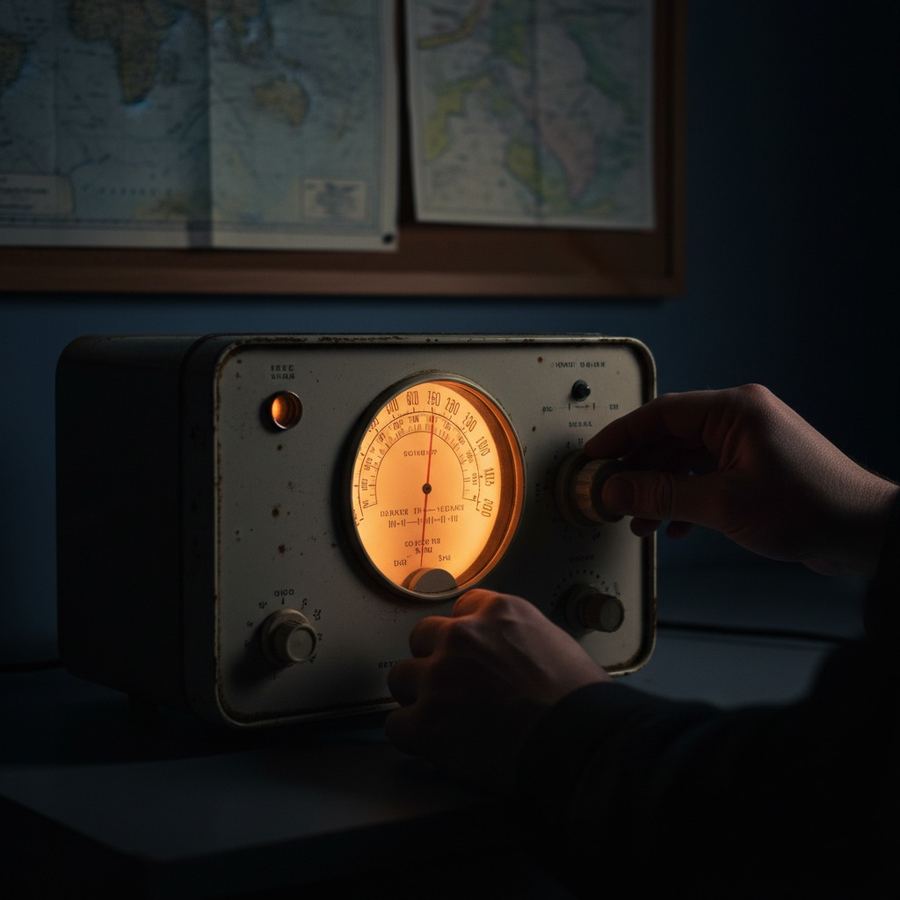
Shortwave is the common name for the high frequency (HF) portion of the radio spectrum, officially 3 to 30 MHz. The reason it matters is propagation. Signals in this range do not travel in a straight line the way FM does. They bounce off the ionosphere, specifically the F layer, and the angle and strength of the bounce depends on solar activity, time of day, and the specific frequency being used. A signal at 9 MHz that is dead at noon can be perfectly readable at 10 p.m. because the D layer has collapsed and the F layer has risen. A signal at 15 MHz that is booming in during mid-afternoon will be gone by sunset because the ionization has dropped below the critical frequency. That is why shortwave listening is a skill rather than a passive activity. You have to know which band to be on at which time of day, and the answers change with the eleven-year solar cycle.
Broadcast shortwave uses specific allocated bands within the HF spectrum, traditionally referenced by their approximate wavelength in meters. The ones still worth knowing are the 49 meter band (5.9 to 6.2 MHz), 41 meter (7.2 to 7.45 MHz), 31 meter (9.4 to 9.9 MHz), 25 meter (11.6 to 12.1 MHz), 19 meter (15.1 to 15.8 MHz), 16 meter (17.48 to 17.9 MHz), 13 meter (21.45 to 21.85 MHz), and 11 meter (25.67 to 26.1 MHz). The lower bands (49m and 41m) are nighttime bands. The higher bands (19m and above) are daytime bands. The 31m band is the workhorse that is usable most of the time for most receivers. If you tune 9400 to 9900 kHz in the evening, something will be there.
What happened to international broadcasting
The peak era of shortwave broadcasting was roughly 1940 through 1990. The Voice of America, the BBC World Service, Radio Moscow, Radio Habana Cuba, Radio Netherlands, Deutsche Welle, Radio Australia, Radio Canada International, and dozens of smaller state broadcasters competed for listeners on every habitable frequency, pumping out hundreds of kilowatts from massive curtain antenna arrays. During the Cold War the shortwave bands were a proxy battlefield.
That era is over. The BBC ended most of its English-language shortwave transmissions to North America and Australasia in 2001 and cut deeper in 2008, citing declining audience and the assumption that listeners would migrate to the web. Radio Netherlands shut down its shortwave service in 2012 and dissolved the parent broadcaster outright in 2013. Radio Canada International went off shortwave in 2012. Deutsche Welle ended its English shortwave in 2011. Radio Australia ended its shortwave broadcasts in 2017. Voice of America has been cut repeatedly and now runs a fraction of the transmitter time it did in the 1980s. The decline is real and worth understanding before you go looking for what is left.
What you can still hear
What is left is still more interesting than the shortlist above would suggest. Religious broadcasters took up significant portions of the spectrum the state services abandoned. WRMI (Radio Miami International) in Okeechobee, Florida, runs multiple 100kW transmitters relaying programming for a long list of lessees, including shortwave hobbyist shows and pirate relay stations. WBCQ in Monticello, Maine, does similar work from a privately owned site. WWCR out of Nashville operates four transmitters running religious and political content. These stations are audible across much of North America and into Europe on decent nights.
Radio Habana Cuba is still on the air with strong signals into North America on 6000 and 9535 kHz in the evening. China Radio International broadcasts in English on multiple frequencies throughout the day. Radio Romania International has a regular English schedule. Voice of Turkey, KBS World Radio from South Korea, and Radio Exterior de Espana from Spain are all still on the air. North Korea's Voice of Korea is strange and audible. Radio New Zealand Pacific still broadcasts to the South Pacific and can be heard in North America on the right night.
Time and frequency standard stations are the most reliable signals on shortwave. WWV in Fort Collins, Colorado, transmits on 2.5, 5, 10, 15, 20, and 25 MHz continuously. WWVH in Hawaii runs on 2.5, 5, 10, and 15 MHz. Both stations broadcast voice time announcements, tones, and propagation data. Tuning in WWV is the universally recommended first shortwave listening exercise because you know exactly what is supposed to be there and you can verify your receiver is working.
Beginner receiver options
A usable starter shortwave radio costs between 30 and 100 dollars new. The Tecsun PL-330 and PL-660 are the current reference beginner portables, covering longwave, AM broadcast, shortwave 1.7 to 30 MHz, FM, and offering single sideband reception, which you need for ham listening. The older Sangean ATS-909X is a more expensive but long-established alternative. Eton Elite Executive portables cover similar ground. At the cheap end, the Tecsun PL-310ET is functional if you can live without single sideband.
At the higher end, the Sony ICF-2010 remains legendary despite being out of production since 2002 and still commands prices above 300 dollars used. For the committed hobbyist, tabletop receivers like the Drake R8B and the Icom IC-R75 offered professional-grade HF reception.
Antennas and where to put them
The single biggest improvement a beginner can make to a shortwave setup is an external wire antenna. The telescoping whip on a portable radio works, but it is an order of magnitude worse than even a crude outdoor wire. A practical beginner antenna is nothing more than 10 to 20 feet of insulated hookup wire strung from the receiver to a window, then out the window to a tree or a drainpipe or a fence post. Connect it to the antenna input jack on the receiver or, if your portable has no antenna jack, clip it to the telescoping whip with an alligator clip.
The rule is that any antenna outside the building is better than any antenna inside the building, because household electronics generate a floor of RF noise that can swamp weak signals.
Logging and QSLs
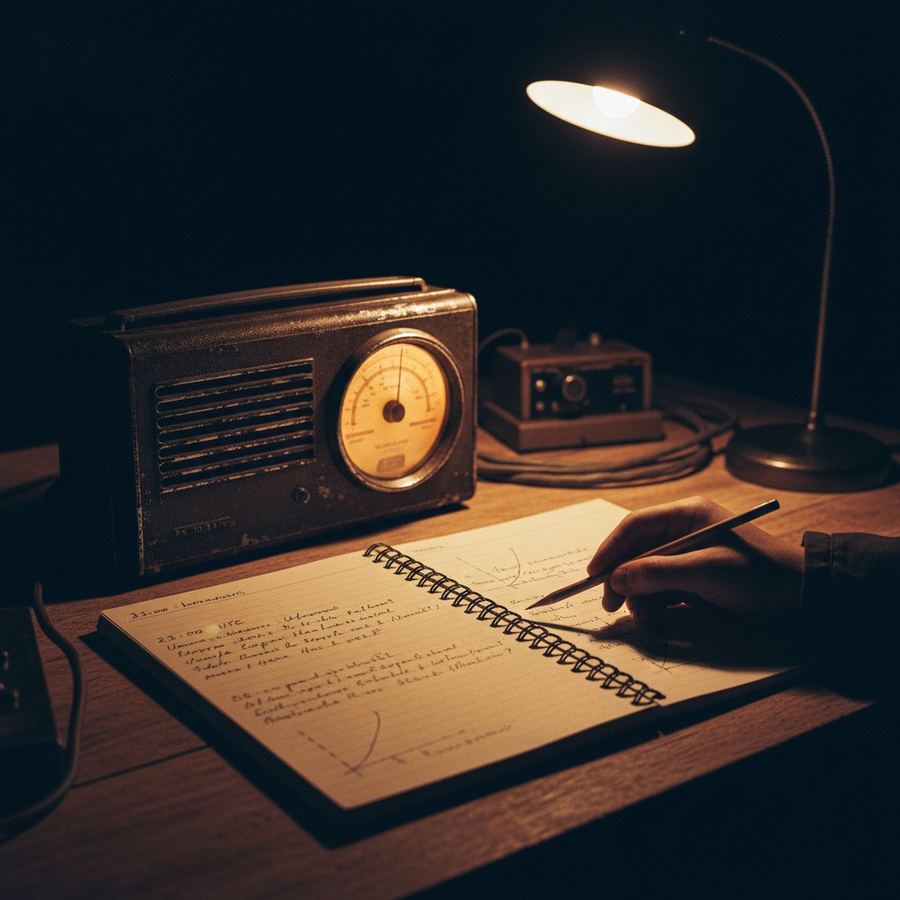
The traditional practice among serious shortwave listeners is to keep a log of every station received: date, time in UTC, frequency, signal quality, and program details. The hobby was built around reporting reception back to the broadcaster and receiving a QSL card in the mail as confirmation. QSL cards are printed acknowledgments, often illustrated with photos of the transmitter site or the home country, and collecting them was the tangible reward of the hobby. Some broadcasters still respond to QSL requests. WRMI will send one. Radio Habana Cuba still mails cards. Time stations WWV and WWVH still process reception reports.
The practice of logging teaches you propagation without meaning to. After a few months of daily listening, you will develop a feel for which bands are open at which times of day in your location and during which part of the solar cycle. That is the skill that separates someone who owns a shortwave radio from someone who knows how to use one.
Why this still matters
Shortwave listening in 2026 is smaller and weirder than it was in 1986, but it is not pointless. The physics of ionospheric propagation still work. The spectrum is still open. A receiver and a wire are still the cheapest possible way to hear a live human voice from another continent without asking a platform's permission. The hobby sits in the same general territory as amateur radio, which uses much of the same spectrum for two-way communication rather than broadcasting. The distinction between the two is explained in our piece on ham bands versus broadcast bands.
If you want a sense of how the shortwave world fits into the larger picture of broadcasting history, see AM versus FM, the cultural shift. And if the appeal of shortwave is primarily about finding voices that do not fit anywhere else on the dial, the same instinct applies to finding good local radio stations on your own FM dial. The tools are different. The search is the same.