A beginner tuning across the shortwave dial for the first time will hear two fundamentally different things without necessarily knowing which is which. On 9750 kHz at 8 p.m. Eastern, a booming AM voice is reading the news in English from Beijing. A few kilohertz up, on 9800, another AM voice is reading the news in English from Bucharest. But tune down to 7200 kHz and switch the receiver to upper sideband, and instead of a broadcaster you hear two people in Ohio and Nova Scotia having a casual conversation about antennas. Both sit in the same general chunk of HF spectrum. Both are perfectly legal. They are doing completely different things under completely different rules.
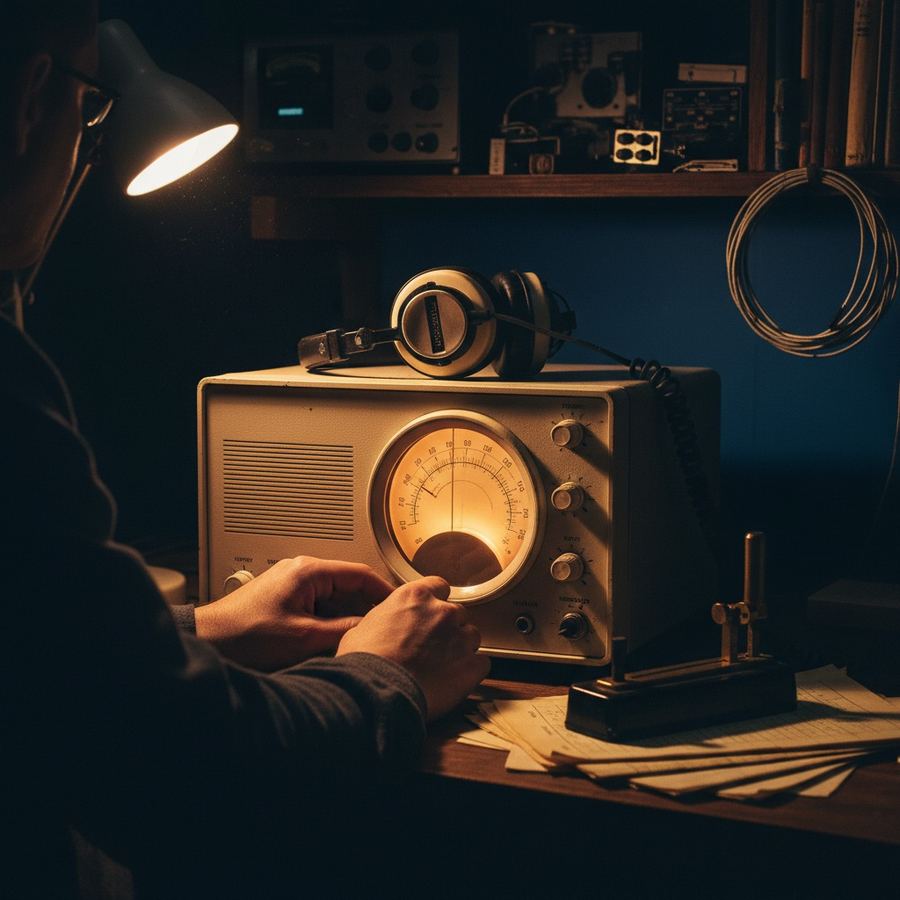
Spectrum allocation in one page
The radio spectrum is a finite public resource. Internationally, it is coordinated by the ITU, which divides the world into three regions and assigns ranges of frequencies to specific services. In the United States, the domestic implementation of those assignments is the FCC Table of Frequency Allocations, published by the FCC and available through fcc.gov. That table is the single authoritative document for who can transmit what, where, and at what power. It is the reason you cannot just build a 500-watt transmitter on 14 MHz and start talking, and it is the reason the guy in Ohio talking to Nova Scotia on 7200 kHz is doing so legally.
The allocations are carved up by service. Broadcasting is one service. Amateur radio (commonly called ham radio) is another. Aeronautical, maritime, fixed, mobile, radiolocation, radio astronomy, and space operation are all separate services with their own assigned slices of spectrum. Two services can share a band in some cases, but the primary versus secondary distinction still governs who has to yield to whom. The practical consequence for a listener is that the shortwave bands you hear on a Tecsun or a Sony ICF-2010 are actually a mosaic of different services, and the difference between a broadcast and a ham conversation is not about the radio spectrum itself, it is about who holds the license to use it and for what.
The broadcast bands
Broadcasting in the regulatory sense means transmitting to the general public with no expectation of a two-way exchange. A broadcast license authorizes the holder to send. Listeners are not required to be licensed. The station is. That is the fundamental legal framework, and the bands reserved for it are familiar.
AM broadcast in North America runs 530 to 1700 kHz, which is in the medium wave portion of the spectrum, below shortwave proper. The standard channel spacing is 10 kHz. Full-power stations run up to 50kW, and Class A clear channel stations at night can be heard across a third of the continent. FM broadcast runs 88 to 108 MHz in the VHF range, with the 88 to 92 MHz slice reserved for non-commercial educational stations. Channel spacing is 200 kHz. Full-power Class C FM stations run up to 100kW ERP. Above 108 MHz is aviation, and then a whole different world of services.
Shortwave broadcasting, unlike AM and FM, is international by design. The bands are coordinated globally through the ITU and follow wavelength conventions: 49 meters (5900 to 6200 kHz), 41 meters (7200 to 7450 kHz), 31 meters (9400 to 9900 kHz), 25 meters (11600 to 12100 kHz), 19 meters (15100 to 15800 kHz), 16 meters (17480 to 17900 kHz), 13 meters (21450 to 21850 kHz), and 11 meters (25670 to 26100 kHz). In these bands you will hear religious broadcasters, state international services, time standards, and the remnants of Cold War era international radio. A fuller walk through what is still audible is in our article on shortwave listening basics for beginners.
The ham bands
Amateur radio, by contrast, is a two-way service. Every participant holds an individual FCC license. The license authorizes the holder to transmit on specific bands, at specific power levels, using specific modes, for non-commercial purposes only. You cannot run advertising. You cannot sell goods over the air. You cannot broadcast to an audience. You can talk, you can send Morse, you can pass messages during an emergency, you can run digital modes, you can bounce signals off the moon or the ionosphere, and you can experiment with almost anything technical that the rules do not specifically forbid.
The HF ham bands in the US are 160 meters (1.8 to 2.0 MHz), 80 meters (3.5 to 4.0 MHz), 40 meters (7.0 to 7.3 MHz), 30 meters (10.1 to 10.15 MHz), 20 meters (14.0 to 14.35 MHz), 17 meters (18.068 to 18.168 MHz), 15 meters (21.0 to 21.45 MHz), 12 meters (24.89 to 24.99 MHz), and 10 meters (28.0 to 29.7 MHz). Each band has its own propagation behavior. 160 and 80 are nighttime bands. 20 meters is the reliable daytime long-distance workhorse. 10 meters opens up dramatically at solar maximum and is nearly dead at solar minimum.
Above HF there are VHF and UHF ham allocations as well. The 6 meter band (50 to 54 MHz) is called the magic band because of its unpredictable sporadic E propagation. The 2 meter band (144 to 148 MHz) is the most active ham band overall, used for FM repeaters, simplex contacts, weak-signal SSB, satellite work, and emergency communications. The 70 centimeter band (420 to 450 MHz) hosts another large repeater population, and 23 centimeters (1240 to 1300 MHz) exists for experimenters.
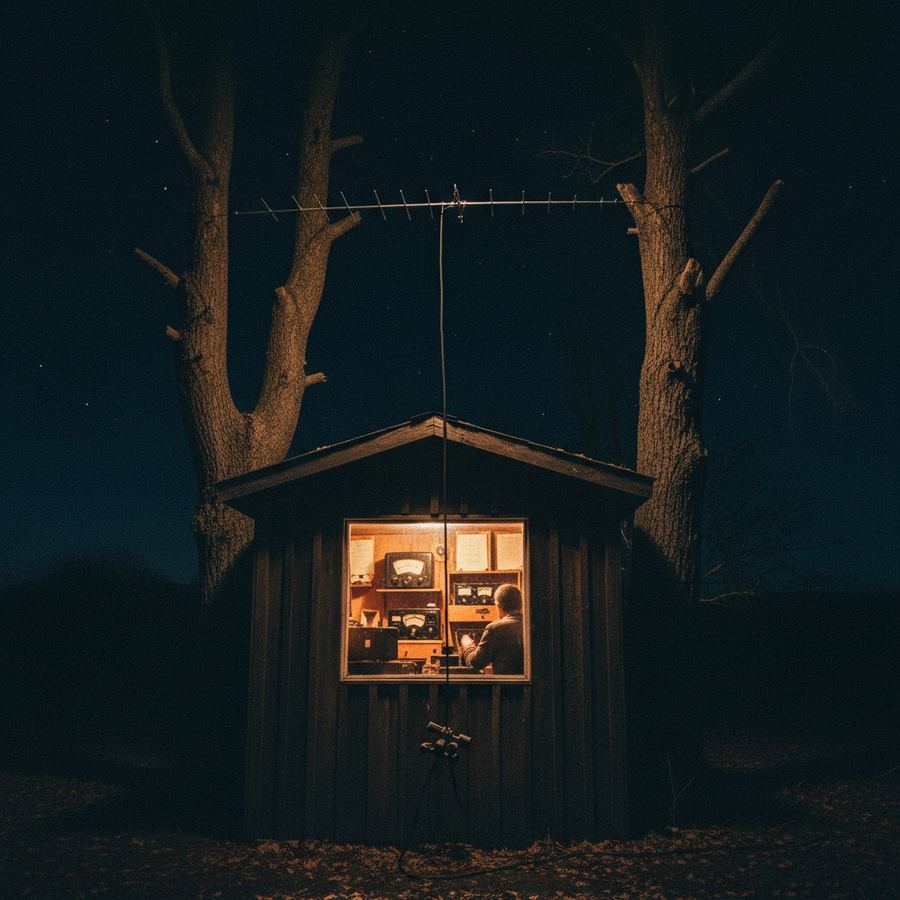
The practical difference
A broadcaster is licensed to send to the public at large. A ham is licensed to communicate two-way with other licensed hams. Both sit on the same general real estate of HF, VHF, and UHF. But everything else about how they operate differs. A broadcaster pays for a frequency allocation tied to a specific geographic coverage area and is accountable to the FCC for content rules, public file requirements, and emergency alert participation. A ham buys a radio, passes a multiple choice exam, gets assigned a call sign, and can operate anywhere in the country on any authorized band at any time of day as long as the operation follows the rules.
The modes differ too. Broadcast shortwave is almost always AM. Ham HF is mostly SSB (single sideband), CW (Morse code), and digital modes like FT8 and PSK31. An AM receiver will demodulate a broadcast station fine but will reproduce an SSB ham conversation as unintelligible Donald Duck noise unless the receiver has a BFO or a dedicated SSB mode. That is the simplest listener-level test of which service you have tuned in.
License classes
The FCC issues amateur radio licenses in three classes: Technician, General, and Amateur Extra. Technician is the entry-level license, requiring a 35-question exam, and grants full VHF and UHF privileges above 30 MHz plus a small slice of HF privileges on 10 meters and a few CW-only segments on 80, 40, and 15. General is the next step, requiring another 35-question exam, and grants substantial HF operating privileges across all ham bands. Amateur Extra is the top license class, requiring a 50-question exam covering advanced technical material, and grants the full allocation of ham frequencies with no remaining restrictions.
The Morse code requirement was dropped in 2007. The national membership organization for amateur radio in the United States is the American Radio Relay League, and its resources at arrl.org are the usual starting point for people looking to get licensed. The ARRL publishes the standard exam study guides and coordinates volunteer examiners who administer the tests.
Emergency communications
The reason ham radio gets mentioned in the context of disaster response, despite being a hobby service, is that amateur operators are often the only working long-distance communications link in the first hours after a major event. When Hurricane Katrina hit the Gulf Coast in 2005, ARES and RACES volunteers (the organized emergency response arms of the amateur service) were running phone patches and health-and-welfare traffic into and out of New Orleans for days while commercial infrastructure was still down. The same happened after Puerto Rico lost its grid in 2017. The same happens on a smaller scale after almost every tornado and wildfire.
That capacity exists because hams already own the equipment, already know how to use it, and already have practiced nets on a regular schedule. The FCC grants amateur radio its spectrum allocations in part because the service has consistently delivered on emergency communications value, and the ARRL leans heavily on that track record in its regulatory advocacy. It is also the reason the ham bands coexist with the broadcast bands in a shared HF spectrum. Both serve a public interest. They just serve it differently.
For more context on how broadcast infrastructure fits into a community, see why local radio still matters, and for the history of specific local stations that went dark, see when stations go dark.