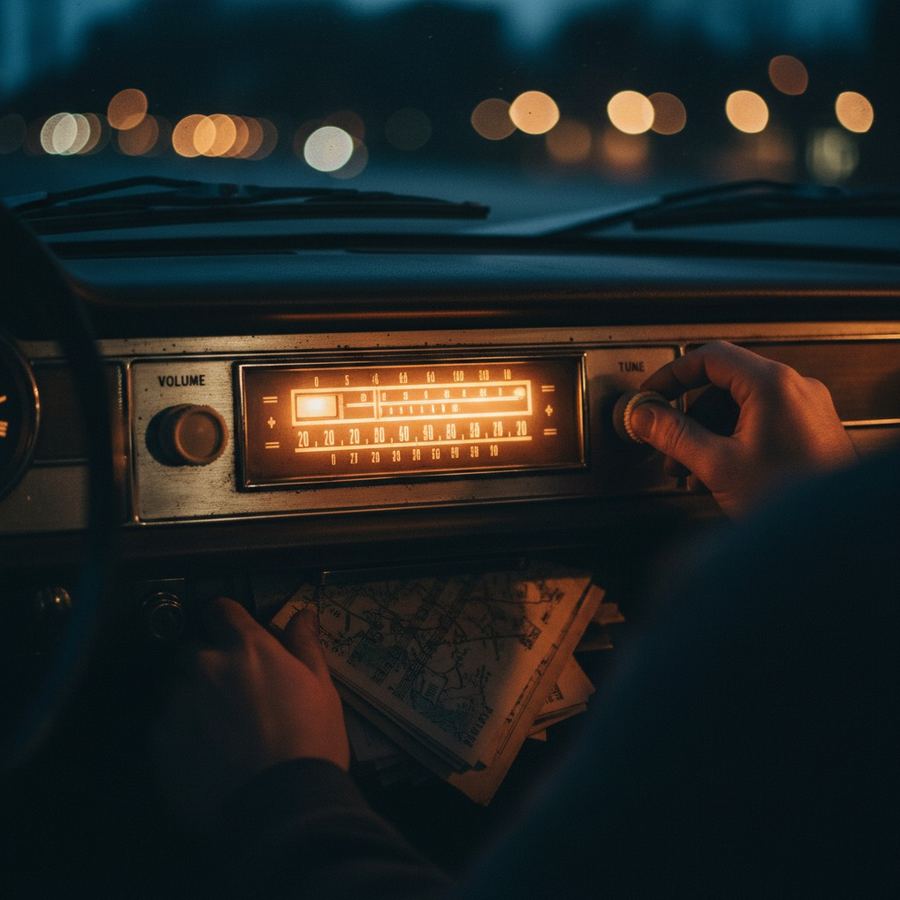
The easiest way to confirm that local radio is in trouble is to drive across three states with the FM radio on scan and listen. Somewhere around the fourth iteration of the same Imagine Dragons single, the same voice-tracked DJ break about "your weekend on the Mix," and the same cluster of national advertisers running the exact same 60-second spots you heard in the last market, the problem becomes audible. You are not picking up different radio stations. You are picking up different transmitter sites for the same programming. Finding the stations that are still actually local, still live, still worth having in the car, takes a little work. Not much, but some.
Why it got this hard
The short version is that the 1996 Telecommunications Act removed the national ownership cap on radio and triggered a consolidation wave that is still rolling. Companies like Clear Channel (now iHeartMedia) and Cumulus ended up owning hundreds of stations, and the operating logic of a 400-station chain is to run as few live hours as possible. Voice-tracking became the default. A single announcer in a hub studio records an afternoon shift in forty minutes, drops in the local city name from a script, and the file ships out to stations in a dozen markets. The fuller history is in our piece on syndication versus local voice, but the practical effect is that a huge percentage of what sounds like local radio on the FM dial is not.
Scan the dial slowly at off-hours
The best time to audit a local FM dial is between roughly 10 p.m. and 6 a.m., or on a Sunday afternoon. Those are the shifts the corporate chains cover with the thinnest programming, and the contrast with a genuinely local station becomes obvious fast. Start at 88.1 MHz and work up the dial, stopping at every carrier you can hear, even the weak ones. Give each station at least two full segments before judging it. What you are listening for is specific: references to a local business by name, a phone number with a local area code, weather that includes an actual county or township, a song request read off a call-in line, a community event that happened yesterday.
The NCE reserved band at 88 to 92 MHz is where a disproportionate share of the remaining live local radio lives. That is the non-commercial educational slice the FCC protected for college stations, community broadcasters, NPR member stations, and religious non-commercial operators. It is the one part of the dial where the consolidation wave has had the least purchase, because the licenses cannot be sold to a commercial operator. If you are scanning fast and skipping past 88-92, you are skipping past most of what is worth finding.
Listen for the commercials
The single most reliable tell is the advertising. National spots run on corporate chains. The same sixty-second Progressive Insurance read, the same GEICO gecko, the same national pharmacy chain tag. A genuinely local station, especially a small AM daytimer or a community FM, runs local advertising. You will hear the car lot on Highway 14 by name. You will hear the feed store on Main. You will hear a thirty-second spot voiced by the station manager himself because there is no production department. Those are the stations to keep.
A weather update that runs longer than the automated liner is another good sign. Voice-tracked automation can play a pre-recorded "partly cloudy, high of 72" but it cannot add that the county road commission is out plowing, or that the marine forecast on the lake has changed because the wind shifted at noon. When you hear a human being riffing on the weather with detail that obviously came from looking out a window, you have found a live airshift.
Use the FCC public file and station databases
Every licensed broadcast station in the United States is required to maintain a public file accessible through the FCC website at fcc.gov. That file includes the station's ownership, political advertising disclosures, issues-and-programs lists, and contact information. It is a slow tool, but it is honest. If you search for the stations in your market and every call sign traces back to the same LLC in Texas, that is the whole story. If a station traces back to a local family, a community foundation, a university, or a religious non-profit with an address in town, that is a promising lead.
Radio Locator at radio-locator.com and the FCC's own FM Query and AM Query tools let you see which stations put a listenable signal on your specific address, sorted by power and distance. That matters because half the stations a car radio finds on the edge of a market are 100kW Class C transmitters from 70 miles away, not the local voice you were hoping for. Filter for the stations whose coverage contours actually sit over your town, then go look up who owns them.
Find the LPFM stations
Low power FM, authorized by the FCC in January 2000 after a long fight over the Radio Broadcasting Preservation Act, created a whole category of 100-watt community licensees tucked between the full-power stations. These are by law non-commercial, locally owned, and generally staffed by volunteers. There are over 2,000 of them. They broadcast at limited range, usually a three to seven mile radius, so most people have never heard of the one in their own county. The REC Networks LPFM database lists them all. Searching by ZIP code surfaces the ones close enough to receive. Our write-up on how low-power FM changed community radio has more on how the service came to exist and what it has become.
The drive-by test
The simplest field test is a long drive. Pick a route that takes you through several different markets on the same day. Scan the FM dial in each one. If every market sounds the same, you are listening to corporate radio everywhere. If a town of 8,000 suddenly produces a morning guy reading the obituaries off a clipboard, or an AM station broadcasting the middle school basketball game from the gym, or a community FM running a polka show at 2 p.m., you have found something worth keeping on a preset. Write down the frequency and the call sign. You will want those later.
Format clues that narrow the search
Specific format clues point you to the worthwhile stations faster. NPR member stations generally sit in the 88-92 band, run the national feed from 5 a.m. to 9 a.m. and 4 p.m. to 6 p.m. for Morning Edition and All Things Considered, and fill the midday with either classical, jazz, or local talk. The member stations that still run local newsrooms are the ones producing actual original reporting about their region, and current.org tracks which ones those are.
College stations live at the low end of the FM dial too, and they vary wildly depending on how much the parent university tolerates student control. The good ones run genre shows hosted by students who picked their own three-hour block and dig deep into a specific music scene. Community broadcasting licenses, distinct from college stations, often run volunteer DJ programming on similar terms, and the difference between them and public access radio is covered in our piece on public access versus community broadcasting.
Religious independents are worth mentioning because they show up frequently on the dial and are rarely consolidated. The big religious networks like K-LOVE and Air1 are effectively corporate chains that happen to play contemporary Christian music and sound as automated as any iHeart pop station. But an independent religious broadcaster, typically a single AM station owned by a local church or a tiny non-profit, often runs local preaching, local announcements, and a morning program that functions as a community bulletin board for its listeners. If that is the flavor of programming you want, they exist and they are not hard to find.
The exercise is worth doing because a good local station is worth having. It is a different kind of listening than a curated playlist on a streaming app. It is live, it is in your area code, and on the day you actually need it, it is the only thing that works. For related context on why that still matters, see why local radio still matters. Finding the ones still doing the job takes an hour of scanning and a few database lookups. Most people never bother. The ones who do end up with a car preset they actually use.