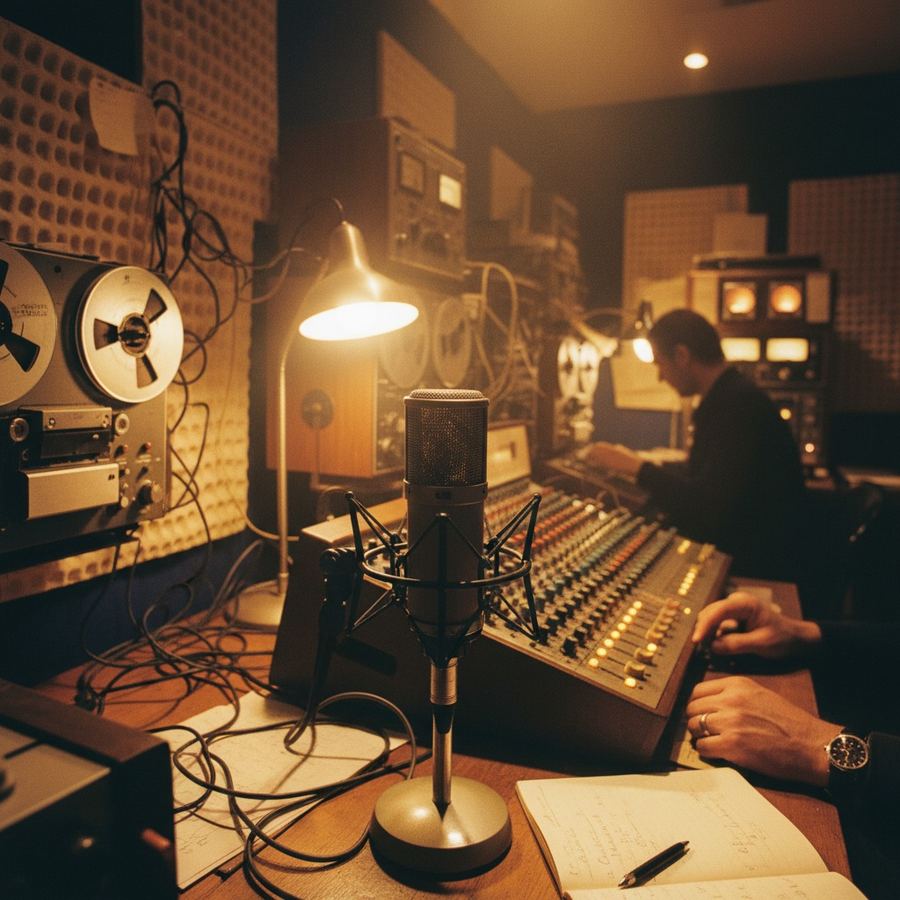
In 2009, Marc Maron was a comedian in his mid-forties whose last regular radio gig, hosting morning drive at Air America, had ended when the network collapsed. He started a podcast called WTF out of his garage in Highland Park, California, using two microphones, a mixer bought on eBay, and a catalog of comedian friends willing to come sit in the garage and talk for an hour. By 2015 the show was pulling six million downloads a month, Maron was interviewing a sitting US president in the same garage, and the career path from broadcast radio to podcasting had been definitively established. Joe Rogan's WTF appearance in 2010 was arguably the inflection point for his own podcast, which by 2020 had become a $100-million exclusive deal with Spotify. Howard Stern went to satellite, not podcasting, but the logic was the same: the people with audiences stopped needing the transmitter.
Where podcasting came from
Podcasting as a distinct format is usually dated to 2004, when Adam Curry and Dave Winer built a workflow around RSS feeds delivering MP3 attachments, and the word "podcast" coalesced from "iPod" and "broadcast" in the tech press. The early years were hobbyist and small. Apple bolted podcast support into iTunes in 2005, which gave the format a distribution directory but not yet an audience.
The format worked because it let anyone publish on-demand audio without negotiating with a broadcaster. NPR was among the first legacy audio institutions to take it seriously. Its mid-2000s podcast catalog included Fresh Air, All Things Considered daily highlights, and versions of existing radio shows republished as on-demand files. Those were essentially repurposed broadcasts, but they trained an audience that on-demand audio could replace appointment listening.
This American Life, produced by WBEZ Chicago, did something slightly different. Ira Glass's show had been a weekly public radio broadcast since 1995. In 2006 it launched a free podcast, and the audience tripled over the next five years with most of the new listeners arriving through podcast. In 2014 This American Life spun off Serial, hosted by Sarah Koenig, and Serial's first season became the first true podcast breakout hit at mass scale. Downloads passed 100 million. At that point the industry noticed.
Who listens and why
Podcast audiences skew younger, more affluent, and more educated than terrestrial radio audiences. Edison Research's Infinite Dial survey has been measuring this for over a decade. The median podcast listener is in their mid-thirties, more likely to have a four-year degree, and more likely to earn above the median household income. The median terrestrial AM/FM listener is older, more geographically spread out, and more likely to be in a car at the moment of listening.
Podcast listening is also more intentional. A listener searches for a show, subscribes to it, and plays episodes when convenient. That is different from the passive "whatever is on when I turn the radio on" mode that characterizes most broadcast listening. A loyal podcast listener will finish a two-hour episode. A casual AM listener will switch stations the moment the song changes.
Those two behaviors are different enough that advertising against them works differently, and the ad economy has started to reflect that. Podcast advertising has grown into a meaningful category, with industry tracking at prx.org covering the non-commercial side and trade coverage at current.org covering the public media side. The commercial podcast ad market is measured in the billions of dollars annually and is still growing faster than terrestrial radio ad revenue, which has been flat to declining for years.
The format differences that matter
Podcasts can be any length. A daily news briefing can run six minutes. A long-form interview show can run three hours. A serialized narrative can hold its audience across twelve 45-minute episodes spread over three months. None of those shapes work on broadcast radio because broadcast radio is a clock-driven medium. The FCC rules require specific station identification at the top of the hour, traditional advertising inventory has to be placed inside a stopset at predictable intervals, and the average drive-time listener is in the car for 22 minutes. Everything on broadcast has to fit inside those constraints.
Podcasts also have no FCC content restrictions. The seven dirty words do not apply. Safe harbor hours do not apply. Indecency complaints do not apply. A podcast can swear, it can discuss whatever it wants, and the only content gatekeeper is the distribution platform's terms of service, which are often much more permissive than the FCC's rules for terrestrial broadcast. That freedom has real creative effects. The long-form conversational style of Marc Maron or Joe Rogan or Terry Gross on extended cuts of Fresh Air would never have survived a broadcast program director's content clock in the 1990s.
Niche subjects also work in podcasting in ways they cannot work in broadcasting. A show about vintage typewriters, or trad jazz between 1923 and 1941, or the history of the Byzantine Empire, can sustain a global audience of twenty thousand listeners indefinitely. That is not enough listeners for a terrestrial station to sell ads against in any specific market. It is more than enough for a podcast supported by a small sponsor roster or a Patreon tier.
What radio still does that podcasts cannot
Live is the biggest one. Sports play-by-play has to be live. A tornado warning has to be live. Breaking news has to be live. A morning show that takes phone calls from the community has to be live. The whole value of those programs is that the listener and the broadcaster are in the same moment. Podcasts, almost by definition, are not in the same moment as their audience. They are recorded, edited, and downloaded. A few shows do simulcasted live versions or live-to-tape recordings with a live audience, but the format's dominant use is on-demand.
Scheduled also matters more than it sounds. A broadcast station running a weekday morning show from 6 a.m. to 10 a.m. has a different relationship with its audience than a podcast has with its subscribers. The broadcast show is a ritual. It occupies a specific time. It shows up whether the listener wants it to or not, and the listener builds a habit around it. Podcasts build habits differently, through notifications and subscriptions, and the habit is usually about the specific show rather than the time of day. Both are valid. They are just different civic and cultural objects, and one cannot fully replace the other.
Simultaneous reach to a large audience is broadcast-only at the moment that actually matters. An earthquake hits Los Angeles at 11:47 a.m. and broadcast stations in the region go live within a minute. Every car radio tuned to a news station gets the same information at the same time. A podcast covering the same earthquake comes out the next morning, valuable but not the same thing as the live broadcast in the first ten minutes.
Dynamic ad insertion and the advertising landscape
The advertising technology differs in an interesting way. Broadcast radio ads are baked into the air signal. Everyone in the coverage area hears the same spot at the same time. The ad buy is measured by Nielsen PPM ratings and priced against estimated audience at time of day. Podcast ads, by contrast, can be dynamically inserted at the moment of download. The same episode downloaded by a listener in Phoenix and a listener in Boston may carry different ad inventory, targeted by geography, listener profile, or campaign rotation. That capability is closer to digital display advertising than to broadcast, and it gives podcast sellers tools broadcasters do not have.
The old host-read ad, where the person talking on the show personally endorses a product, is increasingly being replaced by pre-produced ads inserted algorithmically. Smaller shows still rely on host-reads. Larger shows run both.
Why the BBC and NPR keep doing both
The most telling evidence that podcasts and radio are not substitutes is that the two largest public audio institutions in the English-speaking world, BBC Radio and NPR, continue to put serious resources into both formats simultaneously. BBC Radio 4 still runs a full broadcast schedule and also publishes a deep podcast catalog. NPR still produces Morning Edition and All Things Considered for broadcast and also runs a podcast operation that includes original shows that were never on the air. Neither institution believes podcasting will replace radio. Neither believes radio will reabsorb podcasting. They treat the two formats as complementary audiences served by complementary delivery methods, and the evidence from twenty years of coexistence is that they are right. For the related infrastructure question, see internet radio versus traditional broadcasting. For why the broadcast side of the equation still matters at all, see why local radio still matters, and for a practical listening angle, see how to find good local radio stations.