Sometime around 1953, a station owner named Todd Storz was sitting in a bar in Omaha watching the jukebox. He had bought KOWH, a struggling 500-watt daytimer, two years earlier with money from the Storz Brewing Company fortune and he was trying to figure out what to do with it. The story, repeated by every radio programmer who has ever had to explain where formatting came from, is that Storz noticed the same records getting played again and again on the jukebox that night. He noticed the waitresses, after the last customers had gone home and they were counting tips, feeding nickels into the machine to play the same records the customers had just played all evening. Nobody wanted to hear something new. Everybody wanted to hear the hits again. Storz went back to KOWH and told his program director, Bill Stewart, that they were going to build a station that did exactly that.
That was the origin of Top 40. Whether the diner scene happened exactly that way or whether it was cleaned up for the press kit afterwards, the resulting format worked. KOWH went from a 4 share to a 45 share in Omaha within about eighteen months. Storz bought WTIX in New Orleans, WHB in Kansas City, WDGY in Minneapolis, and WQAM in Miami, and rolled the same format out to each one. By 1956 the Storz chain was the most profitable small-chain radio operation in the United States and every independent station owner in the country was trying to figure out how to copy what Storz had done.
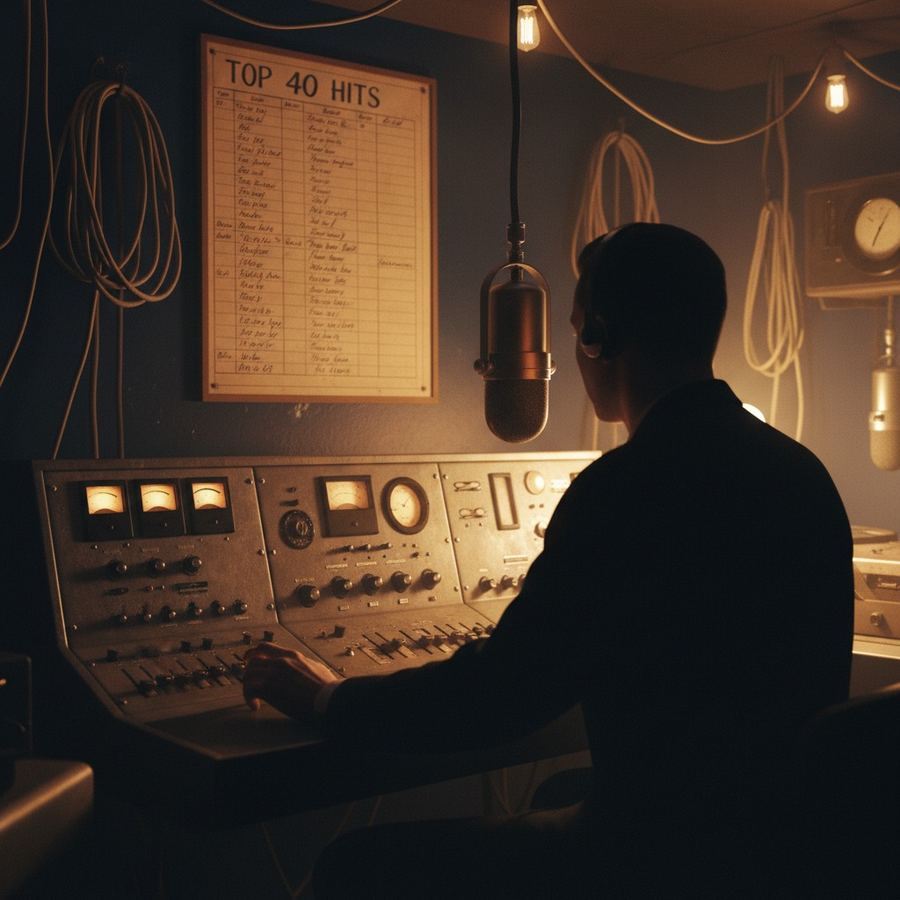
Before the clock, there was block
To understand why formatting was revolutionary, you have to understand what it replaced. Radio in the 1930s and 1940s was block programmed. A station would run a 15-minute morning devotional, then a farm report, then a homemaker show, then a network soap opera, then live country music, then news, then another soap, then kids' adventure serials at 5, then network prime time at 8. Each block had its own audience, its own sponsor, and often its own host who treated the slot like a private fiefdom. You did not tune in a station for a personality or a sound. You tuned in for whatever program was on, and when that program ended, half the audience left. A station was a schedule, not a brand.
When network television arrived after the war and pulled the prime-time entertainment away, radio was left with a lot of empty hours. The disc jockey had already been invented by Martin Block at WNEW New York with the Make Believe Ballroom in 1935 and by Al Jarvis in Los Angeles. But a DJ at the end of the 1940s meant a personality talking between records he had chosen that day, in whatever order felt right. That was block programming with a lighter touch. Storz's insight was that the audience did not want a personality's taste. It wanted the hits, on repeat, with a clock.
The format clock
The format clock is the single most important diagram in commercial radio. It is a literal circle with sixty minute marks around the edge, divided into wedges, and every wedge is labeled with a category of content. A typical Top 40 clock from about 1965 might look like this: at the top of the hour, a five minute network news feed. Back-announce the last song and into a current hit. Commercial stopset. Another current. Jingle. Gold hit from the previous year. Another current. Weather. Commercial stopset. Traffic if morning drive. Current. Personality break, timed to no more than 20 seconds. Current. Jingle. Gold. Commercial stopset. Top of the hour again. Every element has a slot on the wheel and the slot is the same every hour, every day. The DJ does not decide what to play. The music log, generated by the program director against the clock, decides.
The value of the clock was commercial. Advertisers knew exactly when a spot would run relative to music, news, and the top of the hour, and listeners who tuned in at any point got a consistent product. The listener could leave and come back and the station was still the same station. Before formatting, radio did not really have brands. After formatting, it had almost nothing but.
Bill Drake and boss radio
If Storz invented the format, Bill Drake perfected it. Drake, born Philip Yarbrough in Georgia, took over programming at KGB San Diego in 1963 and then at KHJ Los Angeles in 1965, where with Gene Chenault he built what became known as Boss Radio. Drake's innovation was to tighten everything. The music list got shorter, down to about 30 currents rather than 40. The DJ breaks got shorter, often under ten seconds. The jingles got shorter. Dead air got eliminated entirely. The station felt like it was moving. KHJ went from a 2 share to the number one station in Los Angeles inside a year. Drake rolled the format out at KFRC San Francisco, CKLW Detroit-Windsor, and WFIL Philadelphia, and by 1968 the Drake sound was the default template for Top 40 across the country.

Boss Radio was also the point at which the DJ stopped mattering. Drake stations had famous jocks, Robert W. Morgan and the Real Don Steele at KHJ, but the famous part was branding. The talent was not allowed to play what he wanted. He was allowed to introduce what the music log told him to play, in the voice the PD had approved, within the number of seconds the clock allowed. The free-form disc jockey who had followed his own taste was, in the commercial mainstream, finished by about 1966. It survived on college radio and would resurface on early FM.
AOR and the FM migration
FM album-oriented rock was the first serious revolt against tight formatting, and then it became tightly formatted itself. Tom Donahue at KMPX and KSAN in San Francisco in 1967, disgusted with Drake-era AM, put together a free-form FM sound that played full album cuts, long segues, and DJs who talked like people. For about five years, AOR was genuinely free-form on stations like WNEW-FM New York, WMMR Philadelphia, WBCN Boston, and KSAN. Then the consultants arrived. Lee Abrams and the Burkhart-Abrams consultancy turned AOR into a format in the mid-70s by doing exactly what Storz had done twenty years earlier: researching what rock listeners wanted to hear, building a clock around it, and selling the package as Superstars. By 1978, most major-market AOR stations were running a tight clock with a rotating list of about 300 album cuts and the same approved personality style. For more on how FM's technical advantages fed this takeover, see AM versus FM, the cultural shift.
CHR, AC, and consultant culture
By the 1980s, formatting had fragmented into a taxonomy that is still recognizable. Contemporary Hit Radio replaced Top 40 as the name for the currents-driven format. Adult Contemporary covered soft pop and light rock. Album rock and classic rock split AOR in two. Urban contemporary emerged out of the disco and R&B stations. Country, which had run on its own clock since the 1950s, added consultant research and playlist tightening. Each format had its own consultants, its own research firms running call-out studies where listeners were played hooks over the phone and asked to rate them, and its own ideal demographic. The industry's trade press at radioworld.com was full of consultant advertising by 1985 and the station owner who still trusted his own ear was a rare and usually unprofitable figure.
What got lost
Formatting worked. It made radio profitable through the 1970s and 1980s and it gave listeners what research said they wanted. What it erased was local character. A Top 40 station in Omaha in 1954 still sounded like Omaha because the jocks were from Omaha and the morning guy still talked about Omaha. By 1985, a CHR station in Omaha sounded exactly like a CHR station in Fresno because both of them were running the same consultant's clock against the same Billboard chart with the same voiceover package. The trade was consistency for identity, and the 1996 Telecommunications Act would later make that trade permanent by removing ownership caps and allowing the consolidators to apply a single format template across hundreds of stations at once. For the long-form version of that story see our piece on format changes that shaped modern radio, and for the related question of how syndicated programming finished the job, see syndication versus the local voice.
Todd Storz died in 1964 at the age of 39. He did not live to see the format he invented become the template for the entire industry, and he did not live to see it become the template for the industry's decline. What he left behind was the observation that people will pay attention to the same hits played again and again, and that observation turned out to be more durable than the radio business itself.